
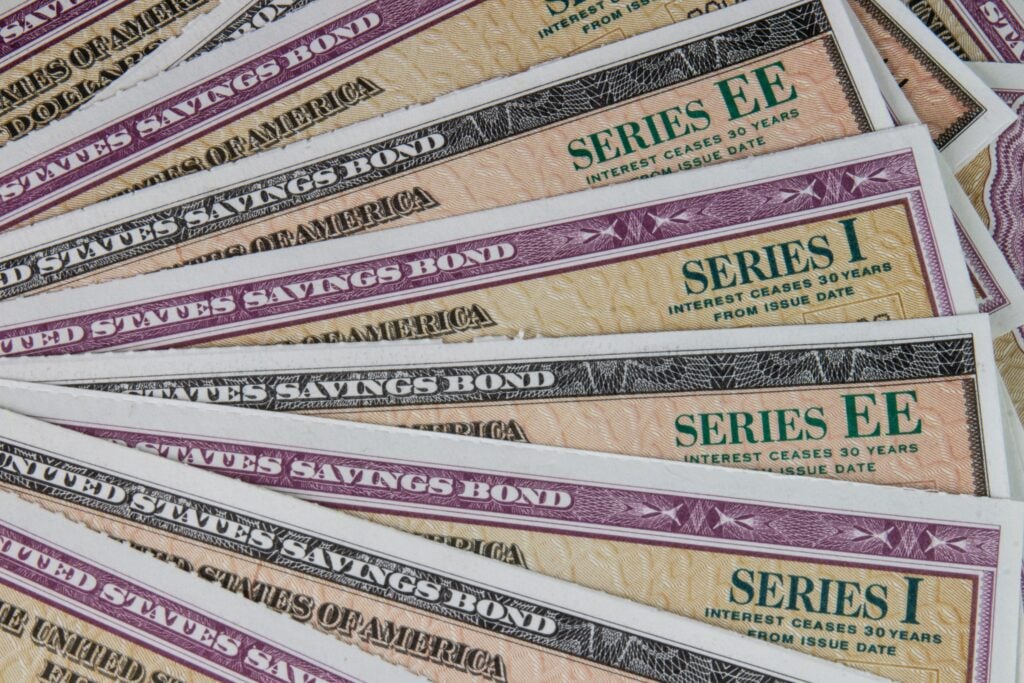
In May 2020, the U.S. government locked in 30-year money at a 1.25% interest rate.
Six years and three months later, it sold $25 billion of new 30-year bonds at 5.216% — the most expensive long-bond auction since 2001, and nearly four times what it paid in 2020.
The price of that repricing shows up in one fund.
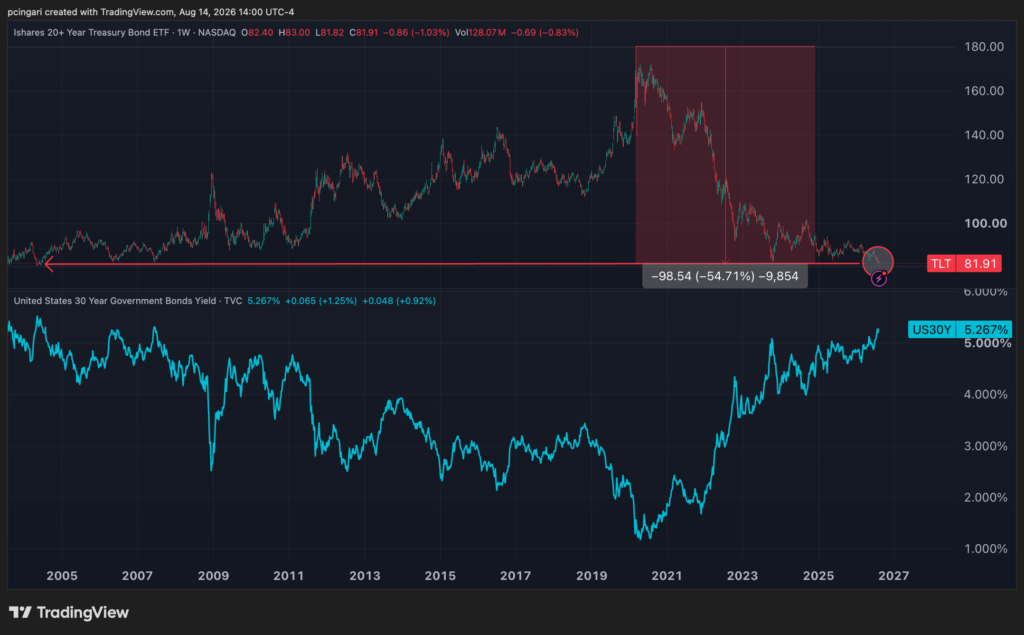
The iShares 20+ Year Treasury Bond ETF (NASDAQ:TLT), the largest fund tracking long-dated U.S. government debt, traded at $81.90 on Friday.
That is the lowest level since June 2004, and roughly 55% below its March 2020 record of $180.
The Auction That Set The Mark
Thursday’s sale was the tell. The new 30-year bond cleared at 5.216%, tailing the when-issued level of 5.212% by 0.4 basis points — meaning buyers demanded a slightly worse price than the market had signaled minutes earlier.
Demand was serviceable, not strong.
The bid-to-cover ratio came in at 2.392, down from 2.444 at July’s auction and below the recent average of 2.429. Indirect bidders, the usual proxy for foreign central banks and overseas real money, took 66.8%, a shade under their 67.0% recent average.
It followed a $42 billion 10-year note auction on Wednesday that cleared at 4.68%, the highest financing cost at that tenor since 2007.
Two consecutive auctions, two multi-decade highs in the government’s borrowing cost.
Inflation Cooled: The Long End Sold Off Anyway
Here is the part that does not fit the usual script.
July consumer prices, released Wednesday, rose 0.1% on the month and 3.4% year-over-year, down from 3.5% in June. Core CPI, which strips out food and energy, rose 0.2% and eased to 2.5% annually — the softest core reading in months.
Both matched the consensus.
Producer prices, out Thursday, were flat for the month as energy and food fell 3.1%.
Softer inflation data would normally rally long bonds. It didn’t. Yields rose into the auction and stayed there.
That tells you the long end is no longer trading on the inflation print.
Where The Pressure Is Actually Coming From
Three forces are doing the work.
- Supply. The federal deficit widened to $432 billion in July, the largest monthly shortfall since March 2021, pushing the trailing 12-month gap to $2.0 trillion. Total public debt is closing in on $40 trillion. Every dollar of that has to find a buyer at a clearing price.
- The Fed leaning to the hawkish side. Three regional bank presidents — Dallas’s Lorie Logan, Cleveland’s Beth Hammack and Minneapolis’s Neel Kashkari — dissented at the July FOMC meeting in favor of a rate hike, not a cut. Markets currently put the odds of a September hike near 35%, down from above 40% before Thursday’s PPI release. Still, there is a 25-basis-point hike fully priced by year-end.
- Capital competition from AI. Hyperscalers are issuing debt at scale to fund data center buildouts. That demand for capital, against a savings pool constrained by aging demographics and tighter immigration, argues for a structurally higher neutral rate — and a fatter term premium on anything with 30 years of duration attached.
Veteran investor Ed Yardeni wrote this week that a 10-year yield between 4.00% and 5.00% is broadly consistent with those fundamentals, adding that “The Bond Vigilantes are not revolting yet.”
This is not an abstraction for households.
The 30-year fixed mortgage averaged 6.67% in Freddie Mac’s Aug. 13 survey, up from 6.58% a year ago. Long Treasury yields set the floor under that number.
The Valuation Argument, Both Ways
At 5.27%, the 30-year Treasury now yields more than the S&P 500’s forward earnings yield.
The index trades at a forward 12-month price-to-earnings ratio of 20.0, per FactSet’s Aug. 7 report — an earnings yield of exactly 5.0%.
For the first time in a long while, the risk-free 30-year pays more than the equity market’s forward profit stream.
Photo: Jonathan Weiss/Shutterstock