
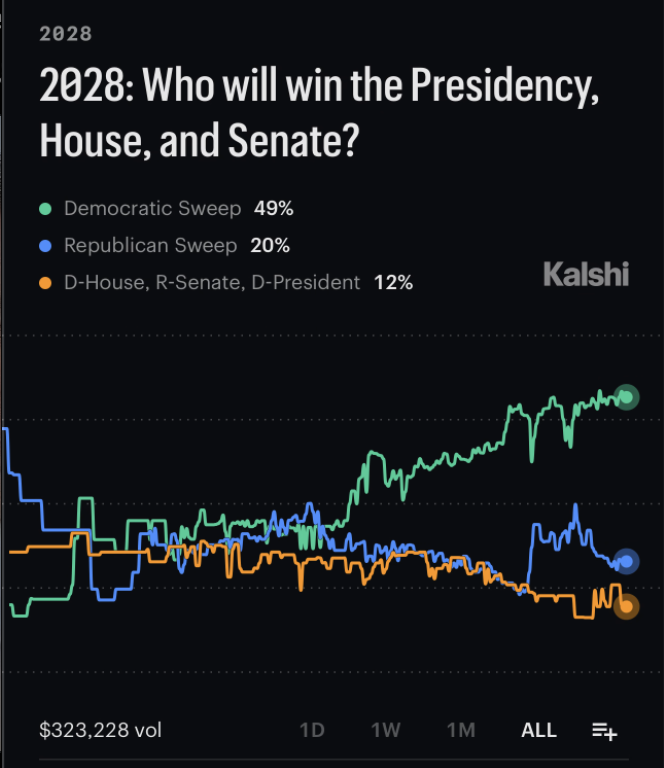
Prediction market Kalshi is increasingly favoring a Democratic sweep in the 2028 U.S. elections, assigning the party a 49% chance of winning the White House, House of Representatives and Senate—more than double the 20% odds for a Republican sweep.
Kalshi Traders Favor Democratic Trifecta
According to Kalshi’s latest 2028 election market, a Democratic sweep—where Democrats win the presidency while retaining control of both the House and Senate—is now the market’s most likely outcome at 49%.
By comparison, a Republican sweep, in which Republicans capture all three, is priced at 20%.
The third-most likely outcome, at 12%, is a split government where Democrats win the White House and House while Republicans hold the Senate.
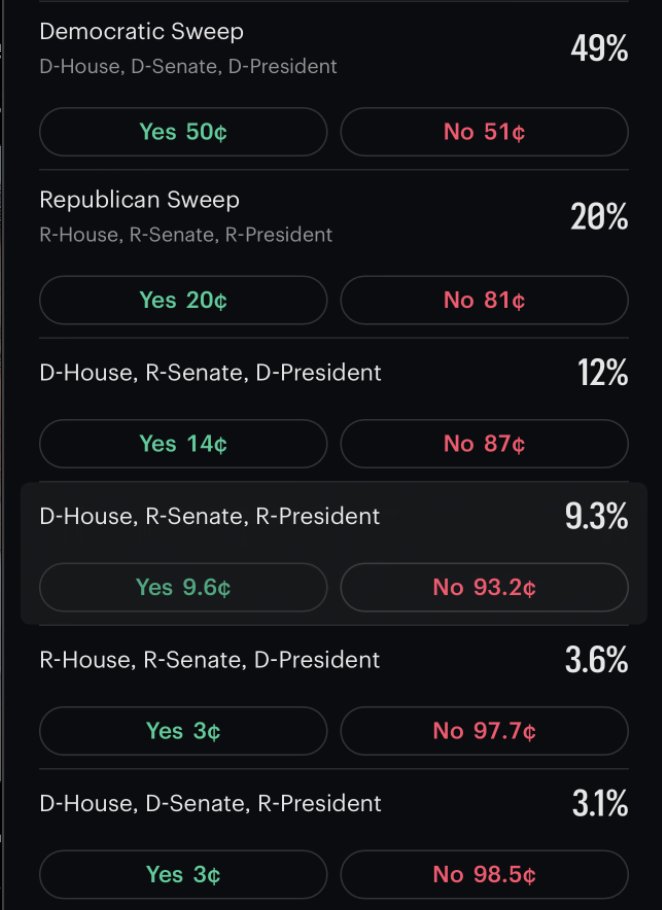
Other scenarios currently trail by single-digit probabilities, including a Republican president with a divided Congress and a Democratic president facing Republican control of one or both chambers.
What the Market is Saying
Kalshi is a regulated prediction market where participants buy and sell contracts tied to future events.
A “Yes” contract pays $1 if the predicted outcome occurs and $0 if it does not, meaning contract prices generally reflect the market’s implied probability.
At the time of writing, a “Yes” contract on a Democratic sweep was trading at about 50 cents, while a Republican sweep contract traded near 20 cents.
Prediction markets are not opinion polls or official forecasts. Instead, they reflect how traders collectively price the probability of future events, with odds changing continuously as new information becomes available.
Appeals Court Rejects Trump’s Voting Order
Last week, a federal appeals court kept in place an injunction blocking key provisions of President Donald Trump’s executive order aimed at increasing oversight of mail-in voting before the upcoming midterm elections.
The lawsuit was filed by Democratic-led states, including California, Massachusetts and Washington, which argued that the executive order exceeded the president’s authority.
Disclaimer: This content was partially produced with the help of AI tools and was reviewed and published by Benzinga editors.
Photo courtesy: Shutterstock