
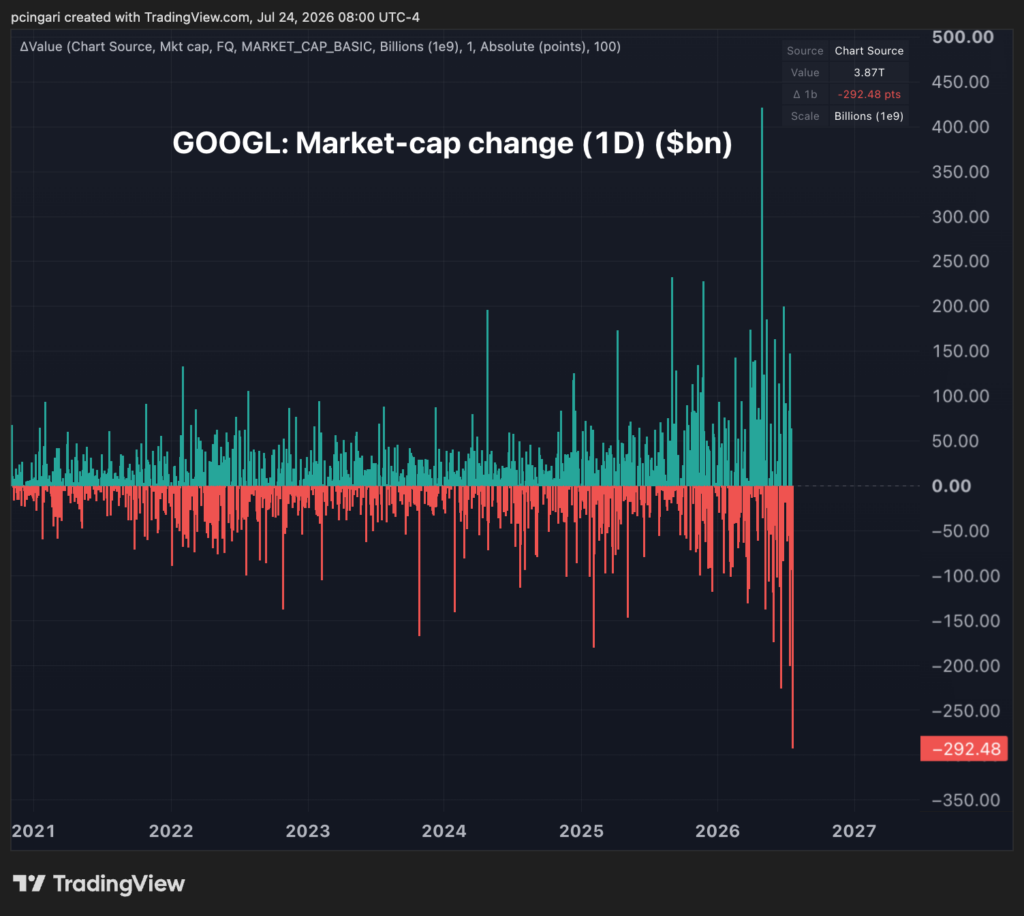
Alphabet Inc. (NASDAQ:GOOG) (NASDAQ:GOOGL) just erased $294 billion in market value in a single session — roughly the size of an entire Palantir Technologies Inc.
The 7.1% plunge marked Alphabet’s worst trading day since May 2025 and the largest one-day destruction of shareholder value in the company’s history. The Google parent’s market value slumped to $3.889 trillion on Thursday, from $4.183 trillion the day before. Palantir’s total market capitalization was $295.8 billion as of Thursday.
Ironically, the Alphabet selloff came after another quarter of record revenues.
Sales rose 24% to $119.8 billion. Google Cloud revenue jumped 82% to $24.8 billion. Earnings landed at $9.11 a share against a $2.88 consensus.
So why did investors punish one of the world’s most profitable companies?
One line on the cash flow statement did the damage.
The New AI Arms Race Isn’t About Revenue
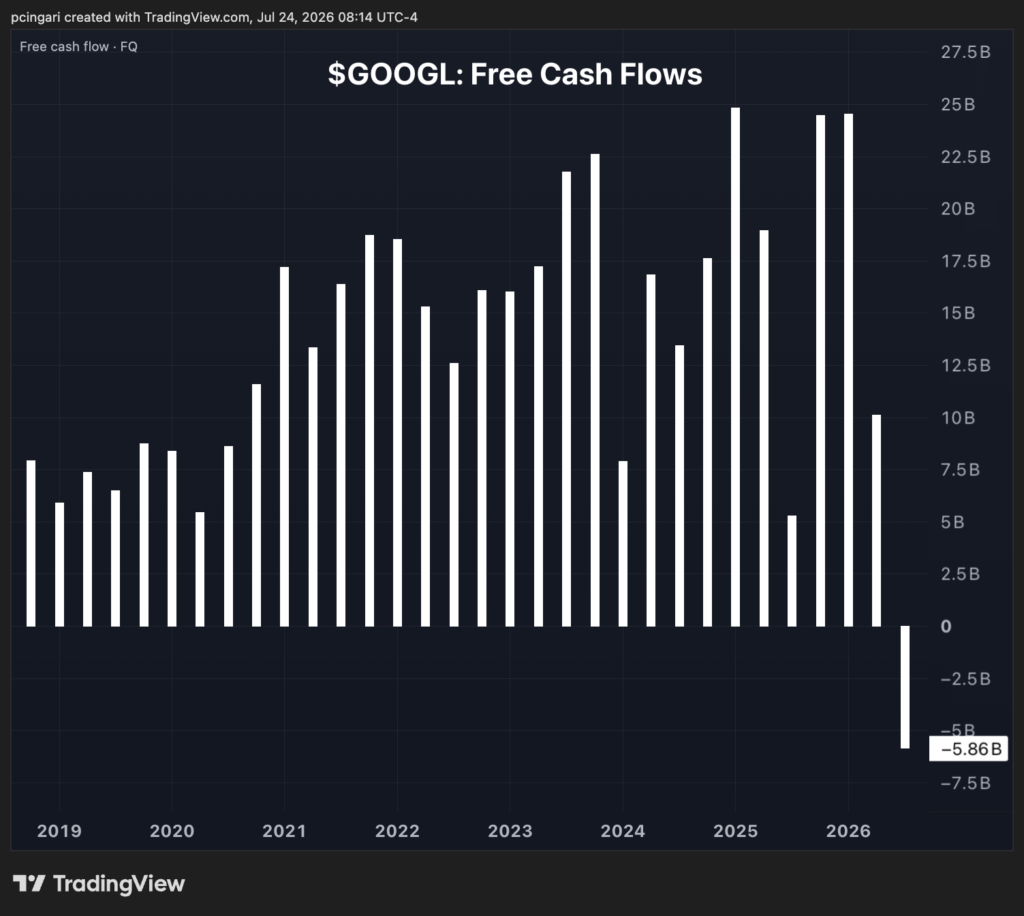
Alphabet generated $39.1 billion in operating cash flow during the second quarter, up 41% from a year earlier.
It spent $44.9 billion on capital expenditure, or capex, the money a company lays out on physical assets like data centers, servers and chips.
Subtract the second number from the first and you get free cash flow, the cash a business has left after paying for its own growth.
It is the money available for dividends, buybacks and debt repayment, and it is the number long-term investors watch most closely.
For the first time in years, Google’s investment bill exceeded the cash its operations generated. Alphabet’s came in at negative $5.9 billion.
The message behind it is even bigger.
Management Called This the New Normal
The number alone might have been absorbed. The guidance was harder to swallow.
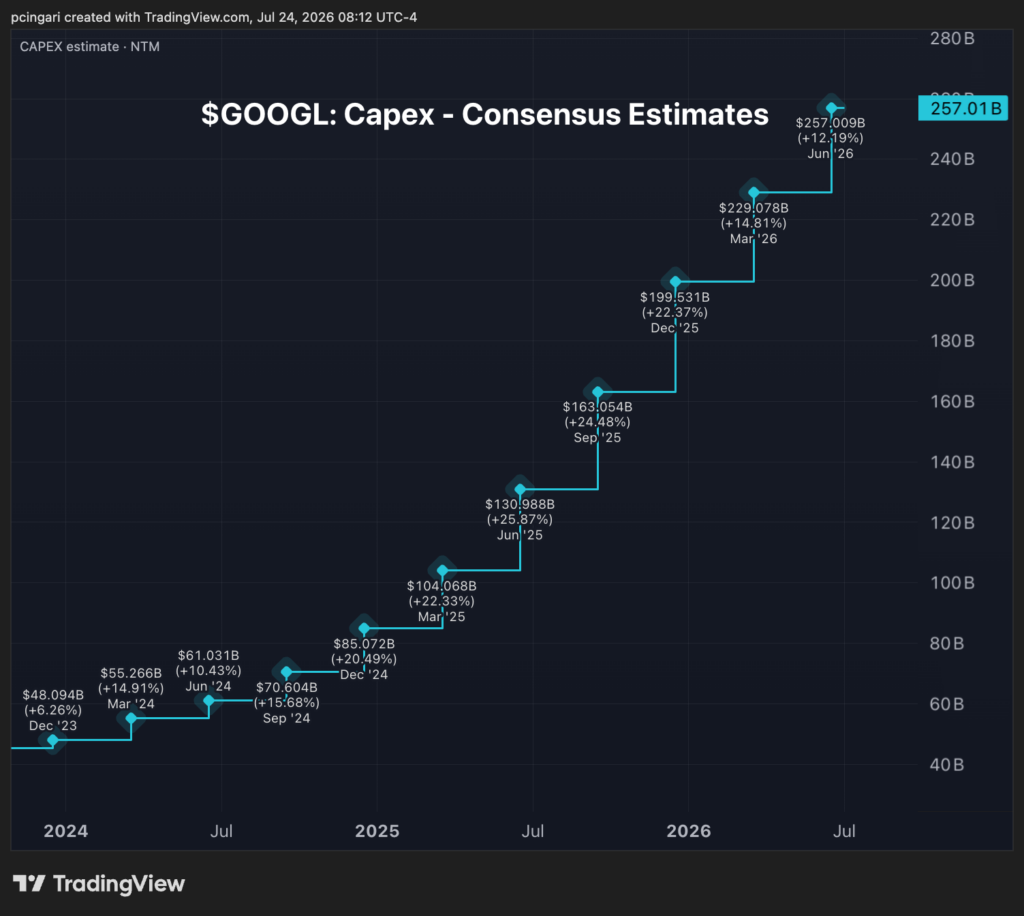
Chief Financial Officer Anat Ashkenazi raised full-year 2026 capex guidance to a range of $195 billion to $205 billion, up from $180 billion to $190 billion, and told analysts the company remains in a supply-constrained environment.
Spending will increase significantly again in 2027.
Analyst consensus now expect Alphabet to spend an unprecedented $257 billion on capital expenditures over the next 12 months.
In other words, Google is no longer behaving like a mature cash machine.
It’s beginning to resemble an infrastructure company whose primary mission is building AI capacity.
Wall Street heard more than a bigger budget. It heard a change in what kind of company Alphabet is.
That is a profound shift.
Alphabet Isn’t Alone in This Boat
This is not an Alphabet story.
Every hyperscaler, the handful of companies large enough to build cloud infrastructure at global scale, is making the same trade.
Amazon.com Inc. (NASDAQ:AMZN), Microsoft Corp. (NASDAQ:MSFT), Meta Platforms Inc. (NASDAQ:META) and Oracle Corp. (NYSE:ORCL).
Trailing twelve-month capital spending now runs at $151 billion for Amazon.com Inc. (NASDAQ:AMZN), $132.4 billion for Alphabet, $97.2 billion for Microsoft Corp. (NASDAQ:MSFT), $75.8 billion for Meta Platforms Inc. (NASDAQ:META) and $55.7 billion for Oracle Corp. (NYSE:ORCL).
Combined, that is $512 billion.
The rate of change is steeper still. Oracle’s trailing capex is up 162% from a year ago, Alphabet’s 98%, Meta’s 73%, Amazon’s 62% and Microsoft’s 58%.
Bank of America has forecast that global hyperscale capex crosses $1 trillion in 2027.
Wall Street has stopped asking who wins the artificial intelligence race.
It is asking what winning costs.
Alphabet has already picked its side.
Image: Shutterstock