
Semiconductor exchange traded funds pulled in the most money on record in July, during the same month their prices fell the hardest since the financial crisis.
The iShares PHLX SOX Semiconductor Sector Index Fund (NASDAQ:SOXX) drew $6.13 billion month-to-date, data from TradingView shows, its largest monthly haul in the data going back to 2018. Over the same stretch the fund fell 18.6%, on pace for its worst month since November 2008.
Chart: Investors Poured $6.13 Billion Into SOXX During Its Worst Month In 18 Years
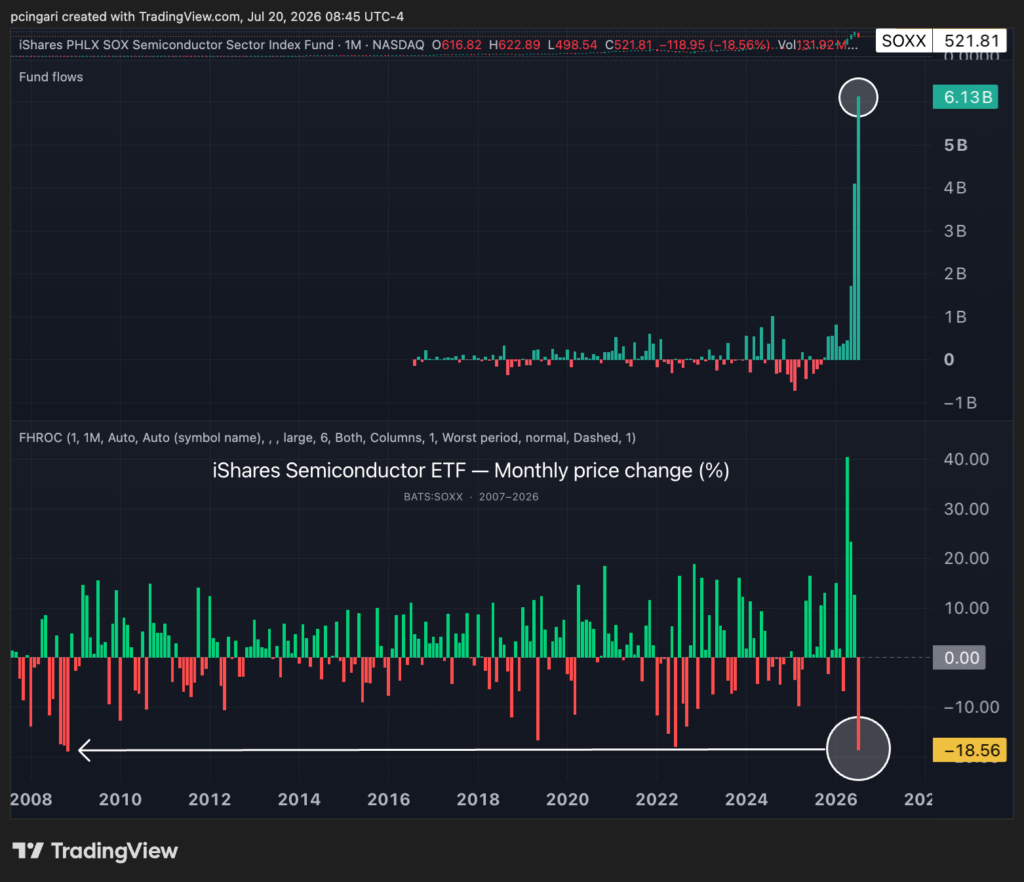
The two facts sit on top of each other. Prices cratered and money rushed in. Investors did not flee the AI trade’s most crowded corner — they leaned into it.
The behavior repeated across the sector’s other AI-linked funds.
The VanEck Semiconductor ETF (NASDAQ:SMH) took in $2.06 billion this month, even as it dropped 15.2%, one of its heaviest inflow readings on record after a brief bout of outflows earlier this year.
The pattern was sharpest where the pain was deepest.
The Roundhill Memory ETF (CBOE: DRAM), a concentrated bet on the memory-chip cycle with top holdings in Micron Technology Inc. (NASDAQ:MU) and SK Hynix, fell 28.6% — steeper than any broad chip fund — yet still pulled in fresh money in only its first few months of trading.
Why Are Investors Buying The Semis Selloff?
Bank of America’s Vivek Arya, the firm’s semiconductor analyst, counted nine drawdowns of more than 10% in the chip index since ChatGPT launched in November 2022, averaging about 14% over roughly 31 days.
In his framing, volatility is not a signal that the thesis is breaking, it is the price of owning the sector.
“We see correction as a summer reset, not a fundamental reversal,” Arya said in a note to clients.
His tracker of hyperscaler capital spending — the money cloud giants pour into data centers — now points toward $1.15 trillion in 2027, an estimate BofA has raised, not cut, through the selloff.
The dip buyers are, in effect, wagering that the fundamentals driving the chip supercycle haven’t cracked.
But Not Everyone Sees A Bottom
Veteran Wall Street investor Ed Yardeni does not.
The Yardeni Research president tied the recent slide to forced selling abroad, pointing to margin calls on Samsung and SK Hynix in South Korea that dragged U.S. memory names lower.
The trigger for Friday’s leg down, he said, came from China: Moonshot’s launch of Kimi K3, a 2.8-trillion-parameter open-weight model the lab claims rivals the best from OpenAI and Anthropic, reviving the DeepSeek-era fear that cheap Chinese models could hollow out demand for expensive U.S. silicon.
Yardeni sees more room to fall.
The S&P 500 semiconductors index, in his view, is likely to drop another 12% to reach its 200-day moving average, the trend line traders watch as a floor.
The money has already voted. Whether it voted early is the open question.
Photo: Shutterstock