

For the past year, one trade defined Wall Street’s artificial intelligence rally: own the chipmakers, avoid the software companies. This month that trade is unwinding faster than it ever has before.
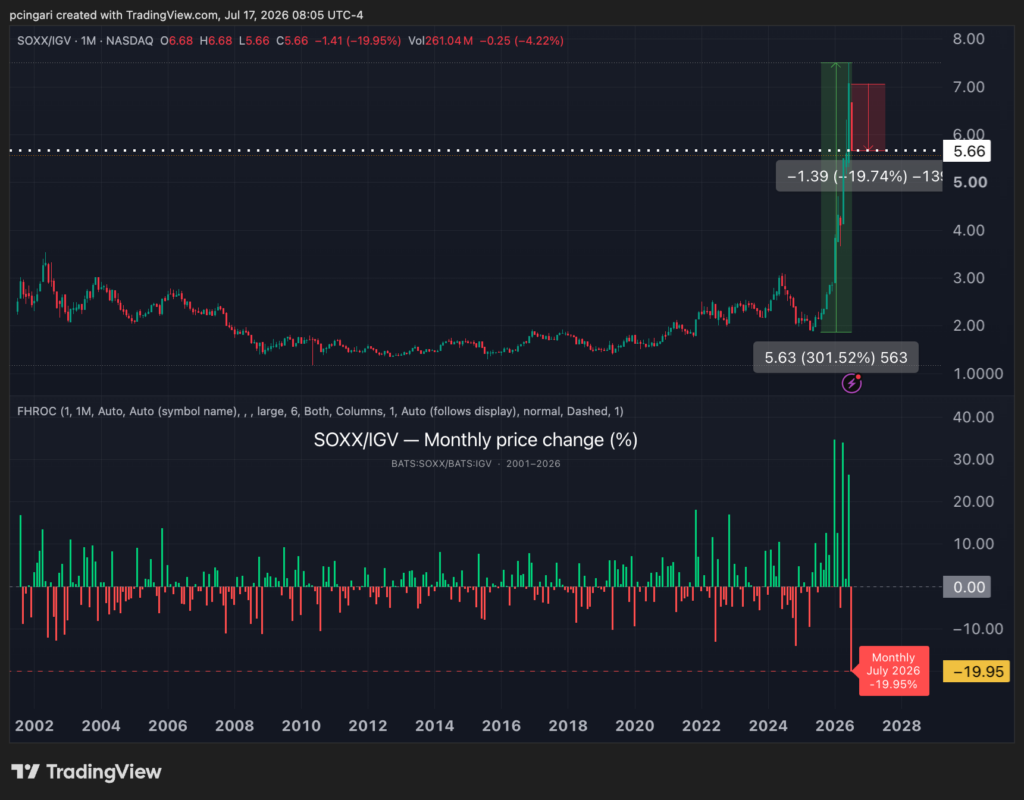
From the April 2025 lows to the mid-June 2026 highs, the iShares Semiconductor ETF (NASDAQ:SOXX) outperformed the iShares Expanded Tech-Software Sector ETF (NASDAQ:IGV) by roughly 300% — a 14-month stretch in which the ratio between the two funds more than quadrupled.
The logic behind that number was simple enough to fit on a napkin. Semiconductors are the physical hardware the AI buildout runs on.
Software, investors decided, is the industry AI eats.
Markets are now sending a different signal.
The SOXX/IGV ratio is down 19.95% month-to-date, on pace for the worst month in the ratio’s history going back to 2001. The previous record on the downside was roughly half that size.
Chart: Semiconductors (SOXX) vs. Software (IGV)
A Selloff With Almost No Survivors
Every single SOXX holding is in the red this month — except one.
Nvidia Corp. (NASDAQ:NVDA) is up 3.65%. Everything else is down, and the median component has lost 22.42%.
The damage is concentrated in the names most levered to AI infrastructure spending.
Marvell Technology Inc. (NASDAQ:MRVL) has dropped 36.79%. Astera Labs Inc. (NASDAQ:ALAB) is off 33.80%, Teradyne Inc. (NASDAQ:TER) 33.39% and Intel Corp. (NASDAQ:INTC) 30.55% — after the chipmaker had been the sector’s biggest upside surprise of 2026.
Software has gone the other way. The IGV ETF is up roughly 4% in July.
What Broke in the Chip Trade?
Three things happened at once.
The first is mechanical. After a 15-month run of that magnitude, positioning was crowded and profit-taking needed no excuse.
The second is the capex question. Investors have started asking whether hyperscalers — Microsoft, Amazon, Alphabet and Meta — can keep growing AI capital spending at the pace already priced into chip valuations.
The Big Four are still guiding to combined AI capex up sharply from last year, but the market is now trading the second derivative, which is the speed of change not the level.
The third arrived last Friday. Beijing-based Moonshot AI released Kimi K3, a 2.8-trillion-parameter open-weight model the company says performs close to Anthropic’s frontier systems, priced at roughly $12 per million tokens. Third-party evaluators ranked it second overall behind Anthropic’s Fable 5 and ahead of OpenAI’s GPT-5.6 Sol.
If frontier-level intelligence can be downloaded rather than rented, the arithmetic on how many chips the world needs — and who captures the margin — changes.
Do the Fundamentals Justify It?
Not yet, and that is the important part.
Semiconductor earnings estimates have not been cut. The selloff has come entirely out of the multiple, not the numbers.
SOXX now trades at 23.8 times forward earnings — the price investors pay for each dollar of profit the sector is expected to earn over the next twelve months.
That sits below the 24.8 times average of the past two years and near the low end of its recent range. Chips are no longer expensive relative to their own recent history.
Software tells the opposite story. IGV trades at 20 times forward earnings, hovering just above two standard deviations below its mean — statistically, about as cheap as the sector has been since the data begins.
A year ago software carried multiples near 40 times, and the ten-year average is 34 times.
The sector has already been re-rated downward on the fear that AI destroys software margins.
Pause or Reversal?
What we are watching is likely a pause in a megatrend that began in mid-2025, not yet its end.
It extends if hyperscaler spending disappoints or if inflation and rates sour risk appetite more broadly. It resumes if second-quarter earnings confirm that chip demand is still compounding.