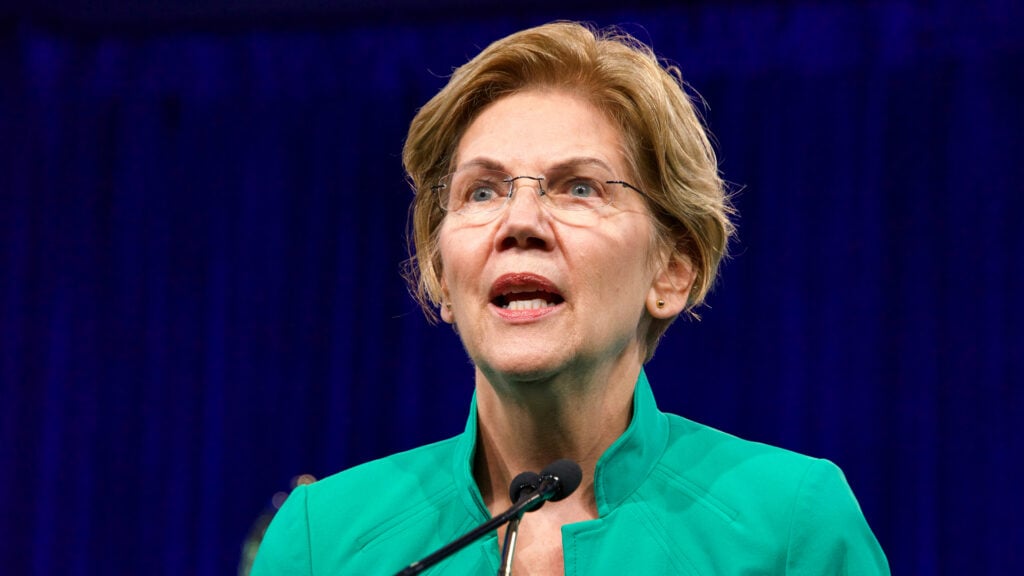
On Tuesday, Sen. Elizabeth Warren (D-Mass.) and economist Peter Schiff shared opposing views about President Donald Trump’s signature tax-and-spending package on social media.
Warren, Schiff Spar Over Trump’s Big, Beautiful Bill
Warren criticized Trump’s “Big, Beautiful Bill” in a post on X, arguing that its tax benefits overwhelmingly favor the wealthiest Americans while offering only modest relief to working families.
She alleged that a family earning $50,000 would receive “less than $2 a day” in tax cuts under the legislation, while households in the top 0.1% would get more than $300,000.
Calling the measure “legalized theft,” she wrote, “This is legalized theft from working people to reward the ultra-rich. We must not forget that.”
Schiff pushed back, rejecting Warren’s characterization of the bill.
“Letting people keep the money they earn is not theft,” Schiff wrote on X. “It’s taking their money and giving it to someone else that’s legalized theft.”
While defending tax cuts, Schiff argued the legislation failed to sufficiently reduce federal spending. He warned that larger budget deficits could ultimately fuel inflation, adding that “the resulting increase in deficit spending lead to theft by inflation.”
Democrats, Trump Administration Remain Deeply Divided
Warren’s comments echo broader Democratic criticism of the legislation.
Sen. Ruben Gallego (D-Ariz.) has accused the bill of transferring wealth from lower-income Americans to the wealthy, while Sen. Chris Van Hollen (D-Md.) argued Republicans financed tax breaks for high-income households by cutting healthcare and food assistance programs.
The Trump administration has defended the legislation as a catalyst for long-term economic growth.
Earlier this year, Treasury Secretary Scott Bessent said the “One Big, Beautiful Bill” would help drive a multi-year expansion, predicting a “non-inflationary boom” in 2026 fueled by stronger business investment, increased manufacturing activity and tax incentives designed to encourage capital spending.
He also pointed to improving GDP projections as evidence that economic momentum was accelerating.
Disclaimer: This content was partially produced with the help of AI tools and was reviewed and published by Benzinga editors.
Photo courtesy: Sheila Fitzgerald / Shutterstock.com