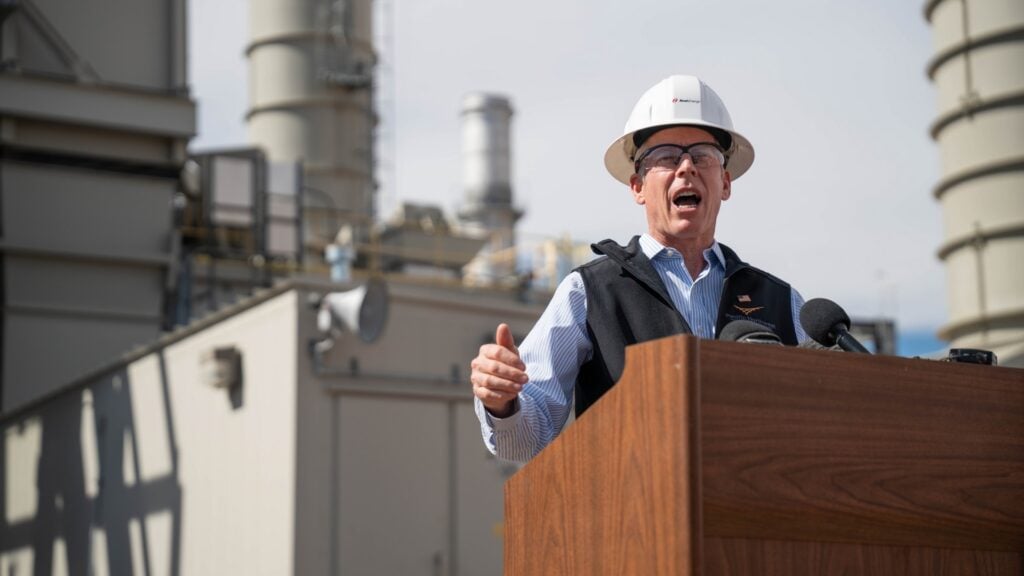
U.S. Energy Secretary Chris Wright pushed back against growing criticism of data center expansion, calling environmental and job-loss concerns “overblown.”
On Tuesday, speaking at an Amazon Web Services conference, Wright said, “The pluses are way bigger than the minuses,” urging industry supporters to counter critics directly.
Wright Defends Water, Power Use
The energy chief argued expanded data center capacity will ultimately lower electricity costs and said water consumption is minimal relative to the benefits. “There’s probably no higher value use of water, full stop,” he said.
Wright compared the backlash to anti-fracking campaigns from 15 years ago, predicting the industry will again prevail over critics.
Tesla Inc. (NASDAQ:TSLA) CEO Elon Musk has backed that view, arguing data centers consume a surprisingly small share of America’s water supply, citing Manhattan Institute data showing they account for just 0.2% of daily U.S. water use.
The Water Math Behind the Debate
The debate has been prominent not only in the U.S. but globally, with environmental concerns remaining central to the discussion.
Data centers depend heavily on fresh water for evaporative cooling because water removes heat from servers more efficiently than air. According to a report by the Environmental and Energy Study Institute, large facilities can consume up to 5 million gallons of water each day, an amount comparable to the daily use of a town with 10,000 to 50,000 residents.
The institute also noted that as AI-focused data centers continue to expand, their demand for water and electricity, along with their carbon emissions, is increasing.
Public Opposition Grows, Billions at Stake
Public opposition has also grown. A Gallup survey conducted in May found that 71% of Americans oppose building data centers near their communities, compared with 53% who oppose nearby nuclear power plants.
Amazon.com Inc. (NASDAQ:AMZN), Meta Platforms Inc. (NASDAQ:META) and Microsoft Corp. (NASDAQ:MSFT) are among the companies facing the strongest local resistance.
Separately, research firm Data Center Watch reported that about $130 billion in data center projects across the United States were blocked or delayed during the first quarter.
Last week, Mark Cuban also argued that the backlash stems less from data centers themselves and more from public anxiety over AI-driven job losses, urging companies to prioritize communities.
In May, billionaire investor Kevin O’Leary, citing a Bitcoin Policy Institute report, said China-linked networks are working to shape public opinion and policy on data center expansion.
Disclaimer: This content was partially produced with the help of AI tools and was reviewed and published by Benzinga editors.
Photo courtesy: Jesse Paul / Shutterstock.com