The Federal Reserve may be preparing to deliver a series of interest-rate hikes that few investors are currently expecting.
Bank of America delivered a sharp hawkish pivot on Monday, telling clients it now expects the Federal Reserve to raise interest rates by 75 basis points before the end of 2026.
The call marks a striking reversal that puts the bank well ahead of the market pricing.
The bank’s economist Aditya Bhave said he sees three straight 25bp hikes in September, October and December, lifting the federal funds rate to 4.25%-4.5%.
That is about 25 basis points more, and three months earlier, than the market, which has priced in two hikes by March 2027.
Bank of America now holds one of the most hawkish rate calls on Wall Street.
Fed’s Warsh Signals Regime Shift
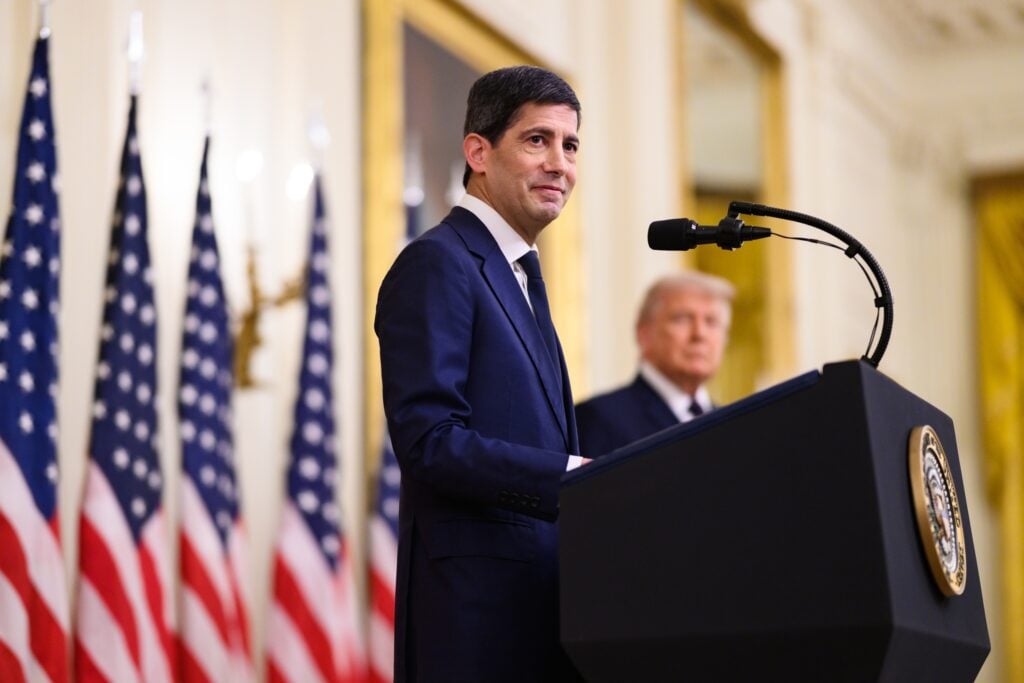
The new forecast follows a more hawkish-than-expected June Federal Open Market Committee meeting and recent comments from Fed Chair Kevin Warsh, which the bank reads as evidence that policymakers have pivoted toward inflation risks.
“The data call for hikes,” Bhave said, adding that both recent economic data and the Fed’s updated reaction function support tighter monetary policy.
The bank described the change as a shift “from risk management to supply shock management.”
Inflation has reaccelerated even as many expected price pressures to keep cooling. Core Personal Consumption Expenditures inflation could reach 3.5% in May, roughly 70 basis points above year-ago levels.
While tariffs and other temporary factors have contributed to the increase, economists believe the Fed is growing less tolerant of repeated supply-side inflation shocks.
Inflation, Bhave said, has “gotten unambiguously worse.”
Strengthening labor-market conditions have also removed one of the main justifications for last year’s easing.
“Powell framed last year’s 75bp of cuts as ‘risk management’ cuts, due to the slowdown in labor data,” Bhave said.
“But the labor market has firmed up this year,” he added.
The hawkish case is reinforced by growth. BofA lifted its second-quarter GDP tracking estimate to 2.8% annualized, driven by a strong May retail sales print alongside upward revisions — hardly the backdrop for a central bank looking to ease.
What It Means For Markets
The call reframes how rate risk is priced.
A Fed tightening into a resilient economy pressures bond prices, pushes yields higher and complicates the rate-sensitive corners of an equity market that rallied to records this year.
In a previous article, we noted that the U.S. dollar index — tracked by the Invesco DB US Dollar Index Bullish Fund (NYSE:UUP) — has historically been one of the biggest beneficiaries of a Fed rate-hike regime.
Investors next turn to Fed Governor Christopher Waller, who delivers remarks Monday in the first key commentary following the hawkish June FOMC meeting, for confirmation that the rest of the committee is leaning the same way.