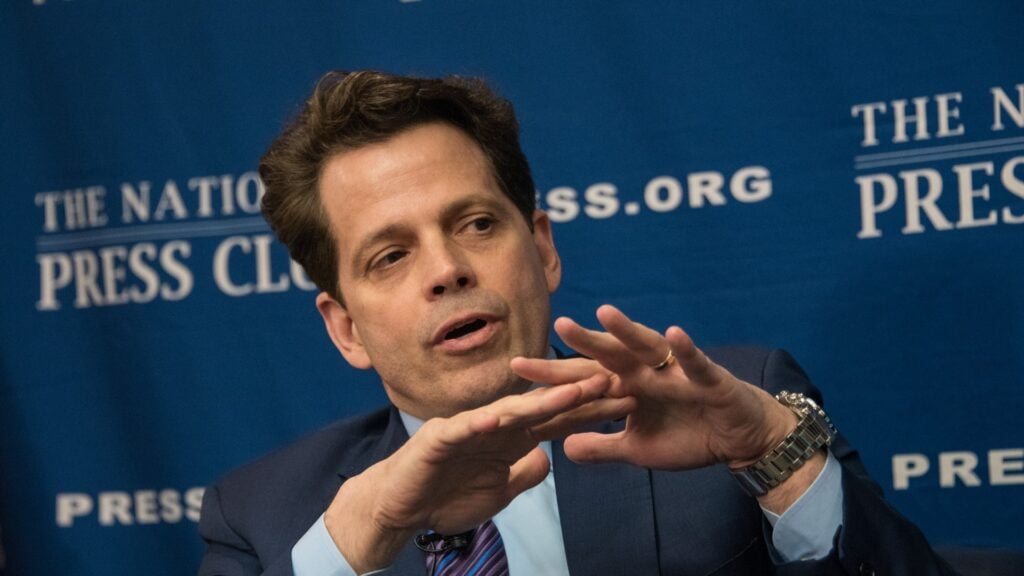
Former White House communications director Anthony Scaramucci criticized President Donald Trump’s economic approach, arguing that rising federal spending and debt levels are pushing the U.S. toward inflation risks and potential financial instability.
Scaramucci Warns US Debt And Inequality
On Saturday, in a post on X, Scaramucci said Trump “has no economic philosophy” and pointed to surging federal spending across administrations.
He said Trump oversaw $8.2 trillion in spending during his first term and is on pace for $9 trillion to $10 trillion in the current term.
“We’re at 100% debt to GDP held by investors. 122% if you count the Fed’s balance sheet,” he wrote, adding that such levels resemble conditions linked to sovereign debt stress.
He also cited investor Ray Dalio, saying high debt typically forces governments toward inflation as an easier way to manage obligations.
Scaramucci said both parties contributed to weakening economic mobility, creating a “K-shaped economy” where higher-income households gain while middle- and lower-income families fall behind.
US Debt Hits 100% Of GDP
Earlier, Sen. Rick Scott (R-Fla.) said persistent federal deficits and rising national debt, not the Federal Reserve or political leaders, were driving economic pressures.
He argued that Congress was responsible, pointing to $39 trillion in debt and about $2 trillion in annual deficits, calling for an end to what he described as excessive spending.
Economist Steve Hanke of Johns Hopkins University also warned that U.S. debt had surpassed 100% of GDP for the first time since World War II, reaching 100.2% in March.
He cited federal debt of $31.27 trillion versus $31.22 trillion in GDP, along with $529 billion in interest payments in early fiscal 2026—nearly equal to defense and education spending combined.
He urged a constitutional “debt brake” to limit borrowing as deficits reached $1.2 trillion over six months.
Dalio separately warned that rising debt and borrowing costs were straining the global financial system.
He compared debt buildup to “plaque” clogging economic circulation, saying financial systems weaken when debt grows faster than income and debt servicing begins to crowd out spending, potentially creating market instability.
Photo courtesy: Shutterstock
Disclaimer: This content was partially produced with the help of AI tools and was reviewed and published by Benzinga editors.