The race to launch ETFs tied to the newly popular MANGOS stock basket is underway, with Yorkville America and Corgi Securities filing products designed to capitalize on investor enthusiasm surrounding artificial intelligence and the blockbuster SpaceX IPO, per a Reuters report.
But while Wall Street is moving quickly to package the theme, the investment case behind MANGOS may be more complicated than the acronym suggests.
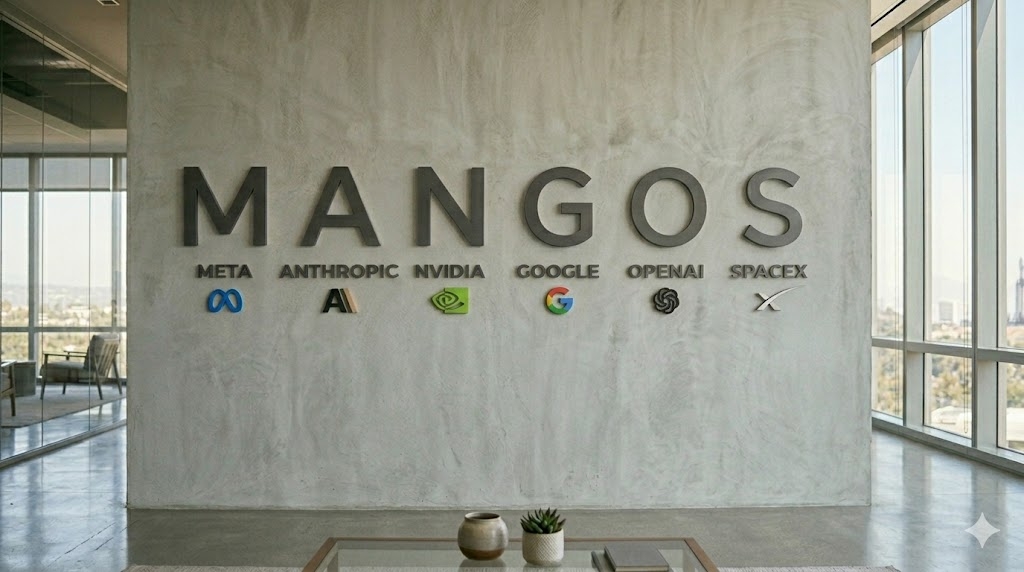
Unlike FAANG or the Magnificent Seven, whose members broadly benefited from the same secular trends, MANGOS brings companies with sharply different—and in some cases conflicting—economic incentives. The basket consists of Meta Platforms, Inc (NASDAQ:META), Anthropic, Nvidia Corp (NASDAQ:NVDA), Alphabet, Inc (Google) (NASDAQ:GOOGL), OpenAI, and Space Exploration Technologies Corp (SpaceX) (NASDAQ:SPCX), a group increasingly viewed as the core infrastructure layer of the AI economy.
From Attention Economy To Infrastructure Economy
The appeal of MANGOS is easy to understand.
MANGOS reflects a different investment narrative: AI infrastructure.
Nvidia supplies the chips powering nearly every major AI model. OpenAI and Anthropic sell foundation models through APIs. Google and Meta are building AI systems embedded across consumer and enterprise products. SpaceX provides connectivity through Starlink, a critical component for data transmission in underserved regions.
The shift from consumer platforms to infrastructure providers helps explain why investors have embraced the acronym so quickly following SpaceX’s record-breaking IPO.
The Meta Contradiction
Yet beneath the narrative lies a structural conflict.
Meta’s open-source Llama models have become one of the biggest competitive threats facing OpenAI and Anthropic. By releasing increasingly capable models at little or no cost, Meta has helped accelerate a sharp decline in AI inference pricing across the industry.
The cost of accessing leading AI models has fallen sharply in recent years as competition intensified and model efficiency improved. According to the 2025 Stanford AI Index, the cost of querying a model with GPT-3.5-level performance dropped from $20 per million tokens in November 2022 to just $0.07 per million tokens by October 2024, a more than 280-fold decline. Open-source models and lower-cost alternatives have further increased pricing pressure across the industry.
For OpenAI and Anthropic, lower pricing can pressure margins and delay profitability. For Meta, however, commoditizing AI models may be strategically beneficial because the company primarily monetizes engagement and advertising rather than model access.
In other words, one of MANGOS’ largest constituents may benefit when the other two face pricing pressure.
Nvidia Remains The Common Denominator
If there is one company that benefits regardless of which AI model ultimately wins, it is Nvidia.
The chipmaker reported data center revenue of $75.2 billion in the first quarter of fiscal 2027, up 92% year over year, underscoring its role as the foundational supplier to the AI ecosystem.
Whether developers choose OpenAI, Anthropic, Meta’s Llama, or Google’s Gemini, demand for computing infrastructure continues to flow through Nvidia’s hardware stack.
That dynamic raises an important question for investors: Is MANGOS really a basket of future winners, or is Nvidia the only constituent with clear exposure to every possible AI outcome?
ETF Issuers Rush To Package The Theme
The first ETF filings suggest issuers are already thinking about the concentration challenge.
Yorkville’s proposed Mango Plus ETF would expand beyond the core MANGOS names by incorporating additional AI-linked companies through what it calls the “Parabolic 7.” Corgi’s filing takes a purer approach, focusing exclusively on the six-company basket.
The filings arrive amid a surge in thematic AI investing. Funds such as the Global X AI & Technology ETF (NASDAQ:AIQ), the Roundhill Generative AI & Technology ETF (NYSE:CHAT), and products from Defiance ETFs have already attracted investors seeking targeted exposure to artificial intelligence.
Unlike those diversified AI portfolios, however, MANGOS represents a concentrated bet on a handful of companies viewed as defining the next phase of AI development.
A Theme Before A Business Model?
The rapid emergence of MANGOS ETFs illustrates how quickly ETF issuers can respond to market narratives.
The bigger question is whether investors are buying exposure to a durable investment theme or simply to a viral acronym.
FAANG worked because its members shared a common economic engine. MANGOS may prove more difficult to evaluate because several constituents compete for the same AI profit pool, while others benefit from making that pool less valuable.
For ETF investors, that tension may ultimately become the most important part of the MANGOS story.
This image was generated using artificial intelligence via Gemini.