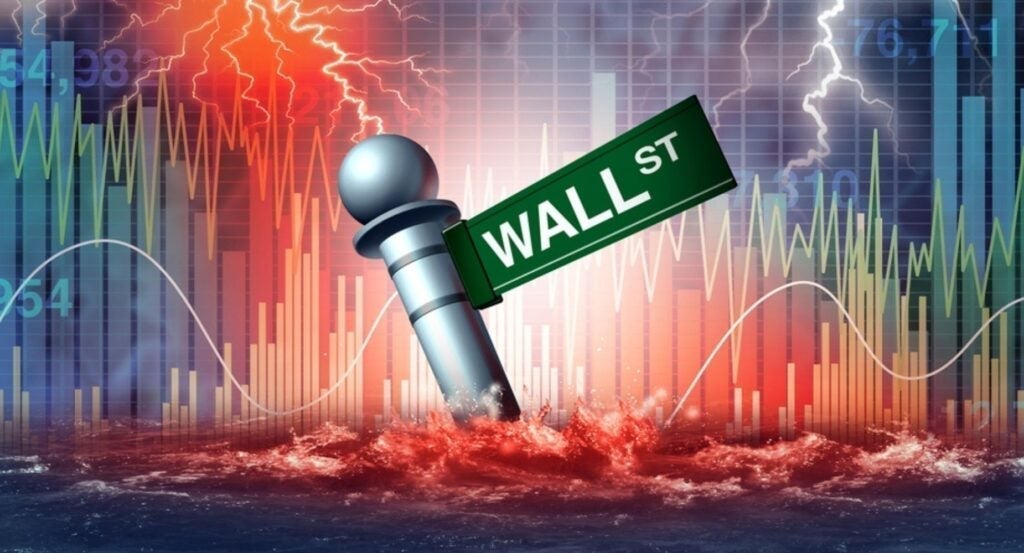
U.S. tech stocks plunged more than 3% by midday Friday after a hotter-than-expected jobs report fueled speculation that the Federal Reserve may raise interest rates later this year.
The economy added a robust 172,000 nonfarm payrolls in May, crushing expectations for 85,000. Payroll gains for March and April were also revised higher by a combined 93,000 jobs. The unemployment rate held steady at 4.3%.
Combined with April’s hot inflation reading, which showed the consumer price index rising 3.8% year over year — the highest level since May 2023 — the labor market data reinforced expectations for further monetary tightening.
Odds of a quarter-point rate hike by year-end surged to near certainty, while money markets priced in a roughly 60% chance of an additional hike in 2027.
Treasury yields moved sharply higher, with the policy-sensitive 2-year Treasury yield jumping more than 10 basis points to 4.15%. The 10-year yield rose to 4.54%. The dollar strengthened broadly, with the trade-weighted U.S. Dollar Index gaining nearly 1% on the day.
On Wall Street, the Nasdaq 100 tumbled 3.2% — putting the tech-heavy benchmark on track for its worst daily decline since October 2025 — as high-growth AI stocks came under pressure from rising rate expectations.
Shares of Micron Technology Inc. (NASDAQ:MU) sank more than 10%, while Broadcom Inc. (NASDAQ:AVGO) fell over 6%, extending Thursday’s 12% decline.
The S&P 500 retreated 1.8%, while the Dow Jones Industrial Average slipped just 0.8%, reflecting its lower exposure to technology stocks.
Small caps fared no better against the yield backdrop, with the Russell 2000 sliding about 2.6%.
The Volatility Index or VIX – known as Wall Street’s fear gauge – jumped 21%.
In commodities, precious metals sold off sharply, with gold down 3.1% and silver plunging nearly 7%.
Meanwhile, the broader cryptocurrency selloff intensified. Bitcoin (CRYPTO: BTC) dropped 4% to $61,000, putting it on pace for a sixth consecutive losing session. Ethereum (CRYPTO: ETH) tumbled nearly 10%, hitting its lowest level since April 2025.
Bitcoin has now fallen 17% this week, putting it on track for its worst weekly performance since November 2022, when the collapse of FTX triggered a broad selloff across digital assets.
Friday’s Performance In Major US Indices
| Index | Last | % Change | MTD | YTD |
|---|---|---|---|---|
| S&P 500 | 7,450.53 | -1.8% | -1.3% | +8.9% |
| Dow Jones | 51,171.16 | -0.8% | +0.5% | +6.5% |
| Nasdaq 100 | 29,366.27 | -3.4% | -2.5% | +12.0% |
| Russell 2000 | 2,856.77 | -2.7% | -2.9% | +9.0% |
According to the Benzinga Pro platform:
- The Vanguard S&P 500 ETF (NYSE:VOO) fell 1.8%.
- The SPDR Dow Jones Industrial Average ETF Trust (NYSE:DIA) slipped 0.8%.
- The Invesco QQQ Trust (NASDAQ:QQQ) tumbled 3.4%.
- The iShares Russell 2000 ETF (NYSE:IWM) dropped 2.6%.
Chips Crater As Defensives Soak Up The Rotation
The Technology Select Sector SPDR Fund (NYSE:XLK) was by far the worst-performing corner of the market, sliding roughly 5% as semiconductors and AI hardware bore the brunt of the Broadcom hangover.
The Materials Select Sector SPDR Fund (NYSE:XLB) and the Energy Select Sector SPDR Fund (NYSE:XLE) each fell about 1.5%, while the Communication Services Select Sector SPDR Fund (NYSE:XLC) and the Consumer Discretionary Select Sector SPDR Fund (NYSE:XLY) dipped near 1%.
Defensive and rate-shielded groups rallied as money rotated out of growth. The Consumer Staples Select Sector SPDR Fund (NYSE:XLP) gained about 2%, the Health Care Select Sector SPDR Fund (NYSE:XLV) rose 1.7%.
The carnage was sharpest at the industry level. The Invesco WilderHill Clean Energy ETF (NYSE:PBW) cratered more than 9% as solar and renewable names sold off on the overhang of accelerating federal tax-credit phaseouts compounded by the jump in yields.
The VanEck Gold Miners ETF (NYSE:GDX) sank roughly 7% as bullion retreated.
Enphase Energy Inc. (NASDAQ:ENPH) led the Russell 1000 lower, tumbling about 15% at the heart of the clean-energy rout tied to the threatened rollback of solar tax credits; sector peer First Solar Inc. (NASDAQ:FSLR) slid roughly 11%.
Lululemon Athletica Inc. (NASDAQ:LULU) tumbled about 11% after cutting its full-year outlook late Thursday. The athleisure retailer lowered fiscal 2026 EPS guidance to $10.95-$11.15 from $12.10-$12.30 and trimmed its sales forecast to $11 billion-$11.15 billion, with interim CEO Meghan Frank citing negative media commentary and product launches that failed to land.
The defensive bid showed up at the top of the leaderboard.
FedEx Freight Holding Company Inc. (NYSE:FDXF) jumped about 8%, extending the strong debut of the less-than-truckload carrier spun off from FedEx on June 1 and freshly added to the S&P 500, as investors continued to assign standalone LTL operators a premium.
The Cooper Companies Inc. (NASDAQ:COO) rallied roughly 7% after its fiscal second-quarter report late Thursday, with revenue up 8% to $1.082 billion and non-GAAP EPS of $1.21, up 26% year over year and ahead of estimates.
Chipotle Mexican Grill Inc. (NYSE:CMG) climbed about 5% after JPMorgan upgraded the burrito chain to Overweight from Neutral with a $35 price target on valuation.
Friday’s Russell 1000 Top Gainers
| Name | % change |
|---|---|
| FedEx Freight Holding Company, Inc. | +8.0% |
| The Cooper Companies, Inc. | +7.4% |
| Coca-Cola Consolidated, Inc. (NASDAQ:COKE) | +5.7% |
| Insulet Corporation (NASDAQ:PODD) | +4.9% |
| Chipotle Mexican Grill, Inc. | +4.8% |
Friday’s Russell 1000 Top Losers
| Name | % change |
|---|---|
| Enphase Energy, Inc. | -14.9% |
| QuantumScape Corporation (NYSE:QS) | -14.1% |
| AST SpaceMobile, Inc. (NASDAQ:ASTS) | -12.5% |
| Allegro MicroSystems, Inc. (NASDAQ:ALGM) | -11.2% |
| Super Micro Computer, Inc. (NASDAQ:SMCI) | -11.0% |
Photo: Lightspring/Shutterstock